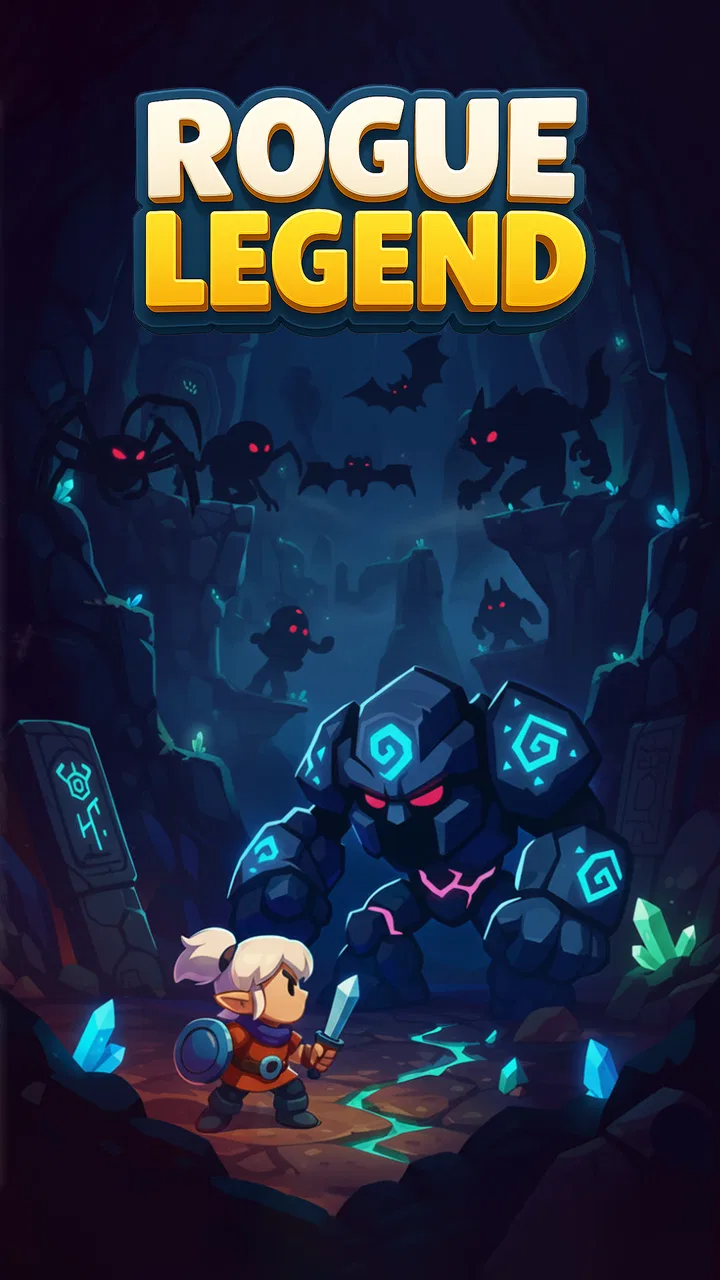
Rogue Legend - Roguelike RPG
- 4.7
- Rating
- 1.00M
- Installs
- Free
- Price

 Analysis by App-foxy
I went into Rogue Legend expecting a quick action RPG, but its appeal became clearer after several sessions: it is built around making sensible choices with limited information, then deciding how much risk I am willing to accept before the next boss. That makes it a better fit for players who enjoy planning between bursts of combat than for anyone looking for a purely relaxed idle game.
Developed by PocketHaven, this free role-playing game combines roguelike runs, character upgrades, boss encounters, and idle progression. It is aimed at Teen players, runs on Android 10 or later, and its current version is 0.410. The store presents it as “Rogue Legend,” but what matters in practice is the way its active and passive elements compete for my attention: I can play deliberately, or I can let progression continue in the background and return when I have something meaningful to improve.
The game has a 4.6 average from around a thousand ratings, with over ten thousand installs. Those figures suggest a small but interested player base rather than a massive mainstream release. I would describe it as a promising choice for people who like compact RPG loops, especially if they enjoy comparing upgrades and adjusting their approach after a failed attempt.
You May Also Like

 Blood Strike: 2.5 Anniversary
Blood Strike’s Loadouts Turn Every Drop Into a Tactical Gamble
A close look at Blood Strike’s custom loadouts: how fast access to signature weapons reshapes its battle royale rhythm, rewards preparation, and narrows the gap between fights.

 Pandora - Music & Podcasts
Pandora’s Music Is Easy to Start, but Harder to Recover
Pandora’s strength is its low-effort path from a seed to a station. Its weak spot is how much confidence it asks you to place in connection, setup, and quiet recovery.

 8 Ball Pool
 Is Built on Rivalries, Rematches, and Routine
A close look at the rivalries, rematches, shared routines, and unanswered safety questions that turn a quick pool match into a persistent mobile community.

 Samsung Music
’s Quiet Strength Is Playing What You Already Own
Its reach comes less from spectacle than from dependable access to a personal library. That simplicity is both the app’s strongest retention engine and its ceiling.

 AccuWeather: Weather Radar
AccuWeather Review: A Quick, Clear Forecast for Everyday Decisions
For everyday plans, the best forecast is the one you can understand quickly. AccuWeather makes rain timing, radar, and local conditions easy to act on, with a few trade-offs.

 Hill Climb Racing
Why Hill Climb Racing Still Turns Crashes Into One More Run
A tiny car, a bumpy hill and one more upgrade: Hill Climb Racing keeps resurfacing because its simple chaos makes every near-miss feel personal.
More From Our News Desk
View All News


How the decisions shape each run
The strongest part of the experience is not simply defeating enemies. It is deciding what kind of run I am trying to build. An upgrade that looks immediately useful may not be the best choice if it leaves the character poorly prepared for a boss. Likewise, pushing farther can be attractive when progress is going well, but stopping to strengthen the character may produce a more reliable long-term result.
That distinction gives the game more personality than a basic auto-battler. In a conventional idle RPG, I can often collect rewards, tap an upgrade, and repeat the same process without thinking much about the order. Here, the roguelike structure makes the timing of those choices feel more important. I pay attention to whether I am solving a short-term problem or building a setup that will remain useful later.
I found it helpful to separate three questions whenever I reached a decision. First, does this upgrade help me survive the next difficult encounter? Second, does it improve the way my character earns progress when I am away? Third, does it leave room for a stronger option later? Thinking this way prevents me from spending every resource simply because an upgrade is available.
That is one of the less obvious strengths of Rogue Legend: the idle layer is more useful when treated as preparation rather than as the whole game. If I only return to collect rewards, the experience can feel shallow. If I use those rewards to prepare for a specific obstacle, the passive progression becomes part of a wider plan.
Active play and idle progress serve different purposes
The game works best when I give each mode a different job. During a focused session, I can watch how the run develops, respond to pressure, and decide whether continuing is worth the danger. During a busy day, the idle side keeps the account moving so that a short return visit still has a purpose.
A realistic use case is a commute or lunch break. I might check the game briefly, collect accumulated progress, make one carefully chosen improvement, and start another attempt before returning to work. That is more satisfying than a game that demands constant attention, but it also means the most rewarding sessions are not necessarily the longest ones.
Players should not confuse idle progression with unlimited convenience. Passive progress can reduce the need to grind manually, but it does not remove the need to make decisions. If a boss exposes a weakness in the current build, simply waiting for more currency may work, but it can also delay the more important task of changing the upgrade direction.
I also recommend avoiding automatic spending whenever possible. Saving resources until I understand the next obstacle gives me flexibility. This is especially useful in a roguelike RPG, where a small improvement in the wrong area can feel less valuable than a well-timed upgrade that solves a specific survival problem.
Risk becomes meaningful near bosses
Boss fights give the progression loop its clearest test. Regular encounters can make a character feel stronger, but a boss reveals whether that strength is balanced or merely comfortable. I learned to treat the approach to a boss as a planning window rather than rushing directly toward the encounter because the next reward looks appealing.
The central trade-off is simple: attempt the fight now and potentially gain momentum, or spend time improving the character first. Neither choice is automatically correct. If the current build is close to succeeding, another attempt may teach me more than passive waiting. If the character is clearly underprepared, repeating the same approach only turns the game into frustration.
This is where the game can reward patience. A failed boss attempt should change my next action. I might save resources, prioritize a different upgrade, or stop treating one impressive statistic as proof that the whole build is ready. The useful lesson is not merely “be stronger”; it is “identify what kind of strength the encounter is demanding.”
That said, the game may feel less satisfying to players who want highly transparent combat calculations. The appeal here comes from the broader loop of preparation and adaptation, not from a detailed tactical battlefield where every action is manually controlled. If you prefer direct skill expression, a more traditional action RPG may offer better moment-to-moment control.
Adaptation matters more than following one perfect build
I do not think this is the kind of game where one fixed upgrade path should be followed blindly. The better habit is to adapt to what the run is giving me and to the obstacle in front of me. A choice that is excellent early may lose value later, while an option that initially seems modest can become important when the difficulty rises.
This creates a useful planning horizon. For the next few encounters, I want enough power to avoid wasting a run. For the next boss, I want a focused improvement that addresses the likely bottleneck. Beyond that, I want to preserve enough flexibility that I am not locked into a weak direction. Managing all three horizons is more interesting than simply selecting the largest visible number.
One practical tip is to keep a short mental record after each failed attempt. I ask myself whether the problem was insufficient damage, poor durability, or inefficient progression. I do not need a spreadsheet to benefit from this; the key is avoiding vague conclusions. “The boss is too hard” is not useful. “My current investment helps normal fights but does not prepare me for the boss” is actionable.
Another useful approach is to judge upgrades by frequency of use, not only by their immediate size. An improvement that helps every stage of a run may be more valuable than one that looks impressive in a single situation. Conversely, a specialized choice can be worthwhile when I am deliberately preparing for a known wall. This is the kind of trade-off that gives a compact RPG loop its depth.
The game is also more approachable when I accept that not every run needs to be perfect. Roguelike design often becomes more enjoyable when a failed attempt is treated as information. I would rather use a short run to test a different plan than spend a long session repeating a comfortable setup that has already shown its limits.
What changes as the account develops
Early progress feels direct because almost every improvement is noticeable. Later, the important question becomes efficiency: which investment produces the best combination of immediate strength and future progress? This is where the idle system becomes more valuable, since it can soften the downtime between active attempts without replacing the need for thoughtful choices.
The long-term appeal depends on whether I enjoy incremental optimization. Players who like watching a character become stronger over repeated sessions will find a clear reason to return. Players who need a constant stream of new environments, story scenes, or dramatic mechanical surprises may find the loop narrower than expected.
There is also a psychological trade-off in the free-to-play structure. The game costs nothing to start, which makes it easy to test without commitment. However, in-app purchases range from $0.99 to $109.99 per item. That broad range means I would approach the store carefully and decide in advance whether I am comfortable spending at all. The best way to evaluate the game is to enjoy the free loop first rather than assuming payment is necessary for the experience to be worthwhile.
For me, the important boundary is whether a purchase would solve a temporary impatience problem or support a genuinely enjoyable part of the game. If I am buying something only because I dislike waiting, I would first reconsider my upgrade plan. If I already like the game and want to support it, that is a more reasonable personal choice, but it should remain separate from judging the quality of the core loop.
The Teen content rating is also worth considering for families. It places the game outside the audience for very young children, so parents should review whether its tone and progression style suit the player. For older players, the rating is less of a concern than the monetization choices and the possibility that repeated progression may become the main focus.
Who should play it, and who should skip it
I would recommend this game to someone who enjoys roguelike structure but does not always have time for a long uninterrupted session. It suits players who like making upgrade decisions, testing a plan against bosses, and returning later to see how idle progress has changed their options.
It is also a good match for RPG fans who enjoy gradual account development more than elaborate storytelling. The combination of active attempts and background growth makes it easy to fit into small pockets of time. A player can engage deeply when available, then use shorter visits for collection and preparation.
I would be more cautious recommending it to someone who wants a fully manual action game. The idle progression changes the rhythm, and the experience is not built around constant precision input. I would also hesitate for players who dislike repeating runs, comparing upgrades, or accepting that a failed attempt may be part of the learning process.
Compared with a standard idle RPG, this offers more reason to think before spending resources. Compared with a traditional roguelike, it is more forgiving of interruptions because progress can continue outside active play. The compromise is that it may not deliver the intense, fully hands-on tension of the best manual roguelikes, nor the effortless simplicity of the most casual idle games.
A practical way to start without wasting progress
My preferred opening routine is deliberately conservative. I first learn how quickly the character improves through ordinary play, then I identify which upgrades affect survival and which mainly improve future accumulation. I avoid spending everything immediately, because early flexibility is more valuable than the temporary satisfaction of filling every available slot or option.
When a boss becomes the next clear target, I stop treating general progress as enough. I review the last attempt and choose one or two priorities rather than scattering resources across every category. This focused approach makes it easier to tell whether the plan worked. If the next attempt fails in the same way, I know the issue is probably strategic rather than simply a lack of time.
For idle sessions, I prefer to leave the game in a state that supports a specific return goal. That might mean collecting enough progress for a meaningful upgrade or preparing for another boss attempt. Returning without a purpose can lead to random spending, while a simple goal keeps the short session useful.
I also suggest setting a personal spending rule before exploring the in-app purchase options. Because the available items span from a very small amount to a much larger one, deciding in advance prevents the store from becoming part of every progression decision. The game is easier to judge when I know whether I am evaluating its free progression or its optional acceleration.
My verdict after weighing the trade-offs
Rogue Legend is most successful when its systems are viewed together. The action gives me a reason to pay attention, the roguelike structure makes each choice carry some uncertainty, boss fights expose weak planning, and idle progression keeps the account moving between sessions. None of those elements alone would be enough for me, but their combination creates a practical rhythm for short and medium play sessions.
Its limitations are just as clear. The experience may feel repetitive if I do not enjoy incremental optimization, and players seeking deep manual combat may want a more directly controlled RPG. The free entry point is welcome, but the wide range of optional purchase prices means I would keep a close eye on spending rather than treating the store as part of the default progression path.
My final recommendation is positive but specific: try it if you want a decision-driven roguelike RPG with idle support, especially one that can fit around a busy schedule. Do not choose it expecting a story-heavy adventure or a pure action game. For me, the best reason to keep playing is the small strategic question before every meaningful attempt: should I push now, adapt the build, or wait until the next improvement makes the risk worthwhile?
That question gives PocketHaven’s game its identity. It is free to begin, available for Android 10 and later, and currently listed as version 0.410. If the idea of balancing immediate progress against better preparation sounds enjoyable, I think it is worth trying. If that kind of repeated planning feels like work, another role-playing game with more direct combat or a stronger narrative focus will probably be a better match.
FAQs for Rogue Legend - Roguelike RPG
01What is the main gameplay style of Rogue Legend - Roguelike RPG?
Rogue Legend - Roguelike RPG is a classic roguelike game that combines RPG elements with randomly generated dungeons. Players navigate through intricate levels, battling enemies, collecting loot, and upgrading their characters. The game emphasizes permadeath, meaning each playthrough is unique, offering a fresh challenge every time you start a new game.
02Does Rogue Legend - Roguelike RPG require an internet connection to play?
No, Rogue Legend - Roguelike RPG does not require an internet connection. It is designed for offline play, allowing users to enjoy the game without needing Wi-Fi or data. This feature makes it perfect for playing while traveling or in areas with limited connectivity, ensuring uninterrupted gameplay.
03Are there in-app purchases in Rogue Legend - Roguelike RPG?
Yes, Rogue Legend - Roguelike RPG includes in-app purchases. These purchases allow players to acquire special items, skins, or power-ups that can enhance the gaming experience. However, the game is designed to be fully enjoyable without spending money, making purchases entirely optional for players.
04What platforms is Rogue Legend - Roguelike RPG available on?
Rogue Legend - Roguelike RPG is available on both Android and iOS platforms. Users can download the game from the Google Play Store for Android devices or the Apple App Store for iOS devices. This availability ensures a wide range of players can access the game on their preferred mobile devices.
05How does permadeath affect gameplay in Rogue Legend - Roguelike RPG?
Permadeath in Rogue Legend - Roguelike RPG means that once your character dies, you must start the game over from the beginning. This feature adds a layer of challenge and excitement, as players must carefully strategize their moves to progress further with each attempt. It encourages learning from mistakes and improving skills with each new game.
Pros
- Engaging and dynamic gameplay.
- Varied character customization.
- Challenging yet rewarding quests.
- Stunning graphics and animations.
- Regular updates with new content.
Cons
- Can be difficult for beginners.
- In-game purchases can be pricey.
- Occasional lag on older devices.
- Requires constant internet connection.
- Limited tutorial for new players.

Rogue Legend - Roguelike RPG
Gallery